May 13, 2026
How ATS Really Works in 2026
Think ATS is automatically rejecting your CV? Learn how Applicant Tracking Systems really work in 2026 and discover how to optimise your CV without falling for common myths.
Modern ATS parse CVs into structured fields and rank them by keyword match, formatting cleanliness, and recency, not by AI "scoring" your personality. Here's how to pass any of them.
If you have applied for jobs recently, chances are you have heard someone say:
“Your CV was rejected by the ATS.”
The problem?
Most people talking about ATS have no idea how it actually works.
Some believe ATS systems automatically reject CVs because of colors, columns, PDFs, icons, or even because they used Canva.
Others think stuffing hundreds of keywords into their CV will magically get them interviews.
The reality is much more nuanced.
And understanding how ATS really works can completely change your job search strategy.
First of All: What Is an ATS?
ATS stands for Applicant Tracking System.
It is software companies use to manage job applications, store candidate profiles, search CVs, rank applicants, and streamline recruitment.
Popular ATS platforms include:
Workday
Greenhouse
Lever
Ashby
SmartRecruiters
Most medium and large companies use some form of ATS today.
In fact, studies estimate that over 98% of Fortune 500 companies rely on ATS software during hiring.
But here’s where people get confused:
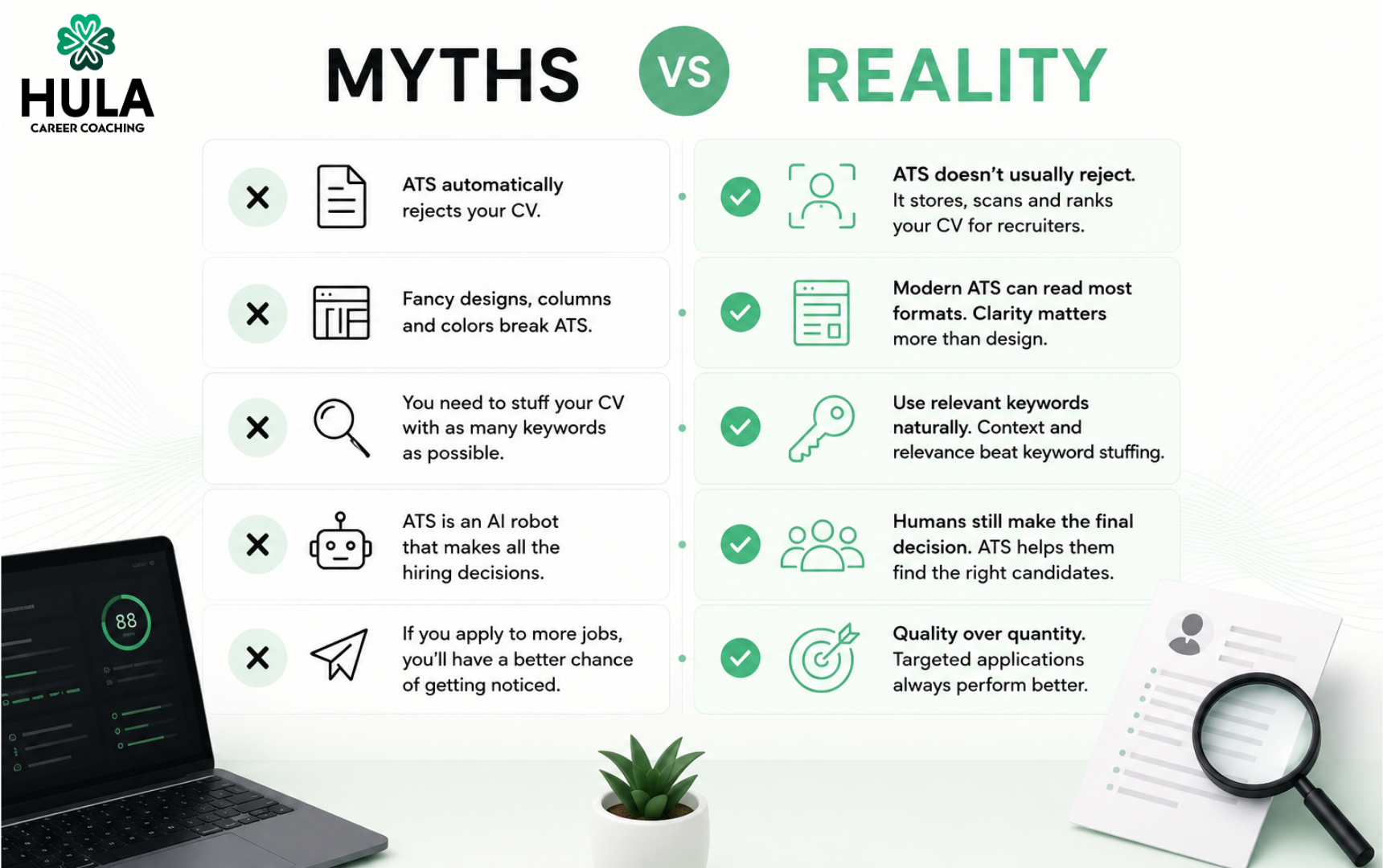
ATS is not usually an “AI robot automatically rejecting everyone.”
Most of the time, ATS acts more like a searchable recruitment database.
The Biggest ATS Myth
One of the biggest myths online is:
“The ATS scans your CV and instantly rejects it if the format is wrong.”
This can happen in some cases if the document is unreadable. But most ATS systems today are much smarter than people think.
Modern ATS platforms can usually read:
PDFs
DOCX files
Basic columns
Cleanly designed CVs
Structured layouts
The real issue is not design.
The real issue is relevance.
What Recruiters Actually Search For
Most recruiters do not manually read 500 CVs one by one. Instead, they search inside the ATS database using filters and keywords.
For example:
A recruiter hiring for a Growth Marketing Manager might search for:
Demand Generation
Paid Media
HubSpot
ABM
Pipeline Growth
SaaS
B2B Marketing
If your CV does not clearly communicate those skills, your chances drop significantly.
Not because “the ATS rejected you.”
But because your CV was never surfaced properly in recruiter searches.
That is a huge difference.
ATS in 2026 Is Becoming AI-Powered
This is where things get interesting. Modern recruitment systems are now integrating AI layers on top of traditional ATS functionality.
This means companies are starting to use AI to:
Compare CVs against job descriptions
Identify missing skills
Rank candidates based on relevance
Detect generic AI-generated content
Evaluate profile consistency
Analyze career progression
This is why blindly copying prompts from TikTok or ChatGPT can actually hurt your application.
Recruiters are increasingly spotting:
Overly generic language
Fake achievements
Keyword stuffing
AI-generated summaries with no personality
Repetitive corporate buzzwords
The future is not about gaming the ATS. It is about optimizing your CV strategically while still sounding human.
The Numbers Job Seekers Should Know
Here are some important realities about modern hiring:
Recruiters often spend less than 10 seconds on an initial CV scan
A single corporate role can receive 300–1000+ applications
Many companies use knockout filters before human review
LinkedIn Easy Apply dramatically increased competition
AI tools made mass-applying easier than ever
This means standing out today requires more than just “having a good CV.”
You need:
Positioning
Keywords
Strategy
Relevance
Clarity
Personal branding
Networking
So How Do You Actually Beat the ATS?
Here is what really works in today’s market.
1. Tailor Your CV for Each Role
Generic CVs perform badly. Your CV should reflect the exact language and priorities from the job description.
Not by copying it blindly. But by aligning your experience with what the company is searching for.
2. Use Relevant Keywords Naturally
Keywords matter. But stuffing 50 keywords at the bottom of your CV is outdated and obvious.
Instead:
-Integrate keywords into achievements
-Mention tools you actually used
-Match industry terminology naturally
3. Focus on Impact, Not Responsibilities
Most CVs say things like:
“Responsible for marketing campaigns.”
Strong CVs say:
“Generated €1.2M pipeline through ABM campaigns across EMEA.”
Specificity wins.
4. Keep the Structure Clear
Your CV should be easy for both humans and systems to understand.
That means:
-Clear section titles
-Clean formatting
-Consistent structure
-Simple fonts
-Logical hierarchy
Good design is fine. Confusing design is not.
5. Stop Applying Blindly
This is probably the biggest mistake job seekers make. Mass applying without strategy rarely works anymore.
The strongest candidates combine:
Optimized CVs
Networking
LinkedIn positioning
Targeted applications
Recruiter outreach
Personal branding
That is how modern job searching works now.
Final Thoughts
ATS systems are not the enemy. The real challenge is understanding how modern hiring actually works. Companies are overwhelmed with applications. Recruiters are overloaded.
AI is changing recruitment fast. And job seekers who rely on outdated advice are falling behind.
The good news?
Once you understand the system, you can start using it strategically instead of fighting against it.
That is exactly why we built HULA Career to help professionals navigate the modern job market with strategy, data, AI, and human guidance combined.
Because getting hired in 2026 is no longer about luck.
It is about career intelligence.

Written by
Hugo F
I've worked with companies like LinkedIn, Indeed and global SaaS organizations, understanding how modern hiring, ATS systems and recruiter processes really work. I've helped 500+ professionals improve their CVs, LinkedIn profiles and job search strategies across Ireland, the UK and Europe. I combined that experience with AI to build something different: A system that doesn't just improve your CV, but gives you a clear strategy to land a job.
Frequently asked questions
Does the ATS actually reject CVs automatically?
Rarely. Most rank CVs and put low-match ones at the bottom of a recruiter's queue. Getting there is the same as being rejected in practice.
Can I use images, columns or text boxes?
Avoid them. Most ATS parsers strip images and misread multi-column layouts.
Is keyword stuffing effective?
No. Modern ATS score keyword density and context, and recruiters see through it in seconds. Mirror the job ad language naturally.
Which ATS should I care about?
Workday, Greenhouse, Lever, SmartRecruiters and Taleo cover most of the market. A clean one-column PDF works across all of them.
Related guides

London vs Dublin 2026: Cost of Living, Salaries and Which Pays Off
A side by side comparison of rent, tax, childcare and salaries in London and Dublin in 2026, and how much you keep at the end of the month in each.

Cost of Living in Cork and Galway 2026: Cheaper Than Dublin, but How Much?
Rent, bills and salaries in Cork and Galway in 2026, how much less you need than in Dublin, and which employers actually hire there.

Cost of Living in Dublin 2026: The Salary You Actually Need
What rent, bills, transport and groceries really cost in Dublin in 2026, and the gross salary a single person, a couple and a family need to live without stress.
Never miss an Ireland job market update
One email a month: newly added visa sponsor companies, salary data, work permit processing times and practical job search tactics.
By subscribing you agree to receive marketing emails from HULA Career. Unsubscribe any time.